



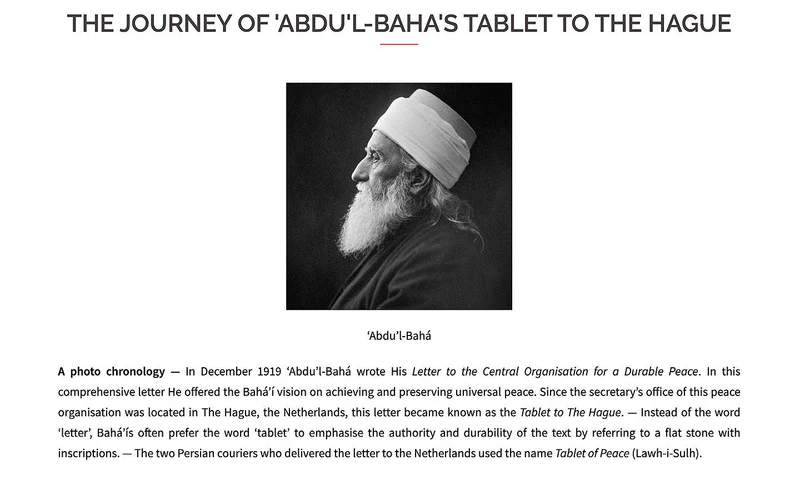
Journey of 'Abdu'l-Bahá's Tablet to the Hague
In December 1919, ‘Abdu’l-Bahá penned a message to the Central Organisation for a Durable Peace, outlining the Bahá’í framework for establishing and safeguarding universal harmony. Known as the Tablet to The Hague, this “Lawh-i-Sulḥ” was carried by two Persian couriers to the Netherlands, its designation reflecting the enduring authority of scripture inscribed on stone. Through this tablet, ‘Abdu’l-Bahá offered principles of collective security, justice and spiritual cooperation, anticipating modern dialogues on global governance and peacebuilding.
A decade ago, ‘Alí Nakhjavání urged a systematic reconstruction of the tablet’s historical milieu, prompting the National Spiritual Assembly of the Bahá’ís of the Netherlands to commission Dr. Jelle de Vries. On its centenary, an online photo chronology presents original documents and images, situating the Tablet’s delivery in context. The resource invites scholars and seekers alike to explore the circumstances surrounding ‘Abdu’l-Bahá’s vision and to deepen their study of its timeless counsel.
Products can be sourced directly from the artists website via the "View Website" button above. If there are concerns related to content then please share a concern.
-
Share a Concern
An email will be sent on your behalf to Bahá’í Distribution Services which manages the Bahá’í Books website.